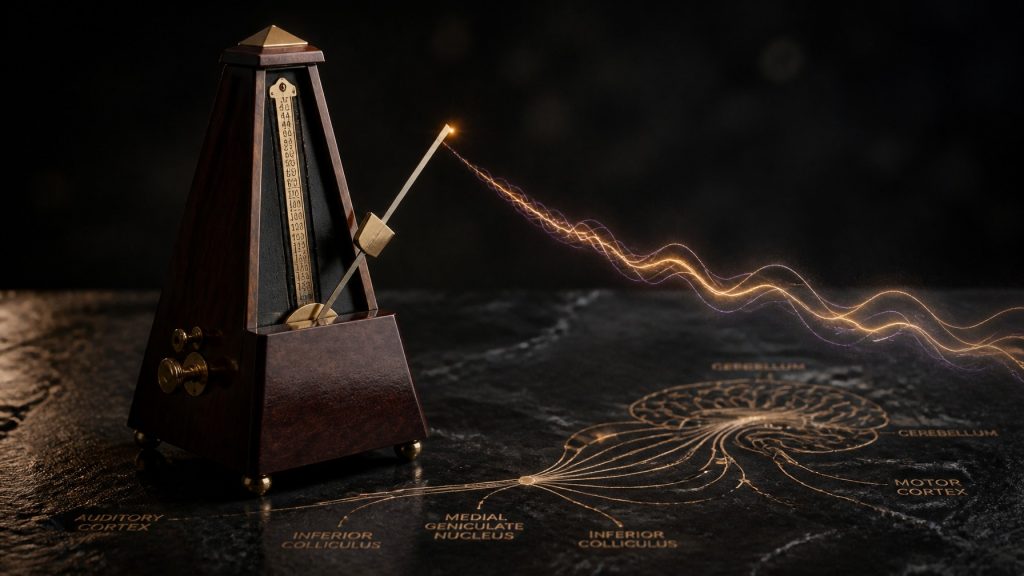
Some people have a strong sense of rhythm because of a mix of brain wiring that tracks timing, musical experience, and genes. A large genetic study found 69 regions of DNA linked to keeping a musical beat, each with only a tiny effect. That means rhythm is shaped by many small genetic nudges working together, not by a single “rhythm gene.”
What Is a Sense of Rhythm?
Scientists call the ability to perceive, predict, and move along with a beat “beat perception and synchronization.” You use it when you tap your foot to a song, clap along at a concert, or fall into step with a walking partner. Researchers consider beat synchronization a fundamental part of musicality, and it shows up in musical experiences across many cultures.
The skill sounds simple, but your brain has to do real work. It listens, predicts when the next beat will land, and sends precise signals to your muscles so your hands or feet arrive on time.
What Did the Biggest Rhythm Study Find?
In 2022, a team of researchers analyzed DNA from 606,825 people who answered a simple question about whether they could clap in time with a musical beat. They reported that beat synchronization has a highly polygenic architecture, with 69 genome-wide significant loci and a SNP-based heritability of 13 to 16 percent. In plain language, many common DNA variations each contribute a sliver, and together they explain a modest share of why people differ.
The team also checked their method. Self-reports matched results from objective tapping tasks, and people with higher genetic scores for rhythm were more likely to be classified as musicians in a separate medical database.
Why Does Rhythm Seem to Run Through the Whole Body?
The same study found that rhythm genes are active in the brain, including during fetal development. It also found genetic overlap between beat synchronization and breathing function, motor function, processing speed, and chronotype, which is your natural sleep and wake schedule. That fits the idea that rhythm is tied to other biological timekeeping, such as walking, breathing, and the body clock.
It also explains why a good sense of rhythm can feel less like a skill you learned and more like something you were born with.
Does Practice Matter?
Practice almost certainly helps people enjoy and refine their rhythm, but the relationship is more complicated than it looks. A well-known study of 10,500 Swedish twins found that music practice itself was substantially heritable, and the link between practice and music ability was largely genetic. Among identical twins who practiced different amounts, there was no difference in ability. The authors suggested that genes may influence both talent and the desire to practice.
That finding is debated, and it does not mean lessons are pointless. It does suggest that some people are drawn to music because their brains reward them for it, which then gives them more practice. Early exposure, such as dancing in the kitchen or drumming on a table, can also help the skill develop.
What If Your Rhythm Is Not So Strong?
Do not panic. The researchers emphasized that these genetic results are not deterministic, so they cannot predict anyone’s ability from DNA alone. Environment, interest, and opportunity still count for a lot. If you want to strengthen your timing, try tapping along with a metronome, walking to a steady beat, dancing, or learning a simple drum pattern. Short, regular sessions tend to work better than long, rare ones.
Many people who think they have no rhythm have simply never practiced it in a relaxed setting. A little playful repetition can go a long way.
Why Does Rhythm Feel So Good?
Moving in time with other people tends to feel social and satisfying. That is one reason clapping at a concert or dancing at a wedding can feel so unifying. Researchers have suggested that beat perception may have supported communication and group bonding, although that idea is still being explored. A strong sense of rhythm may simply make that shared feeling easier to access.
Want to Learn More About Your Own Wiring?
A DNA report cannot tell you whether you can keep a beat, but it can help you explore how your genes relate to broader traits, such as sleep timing and stress response. SelfDecode turns your DNA data into personalized health recommendations, a handy starting point if you are curious. You might also enjoy our posts on the genetic basis of perfect pitch and why some people get goosebumps from music.