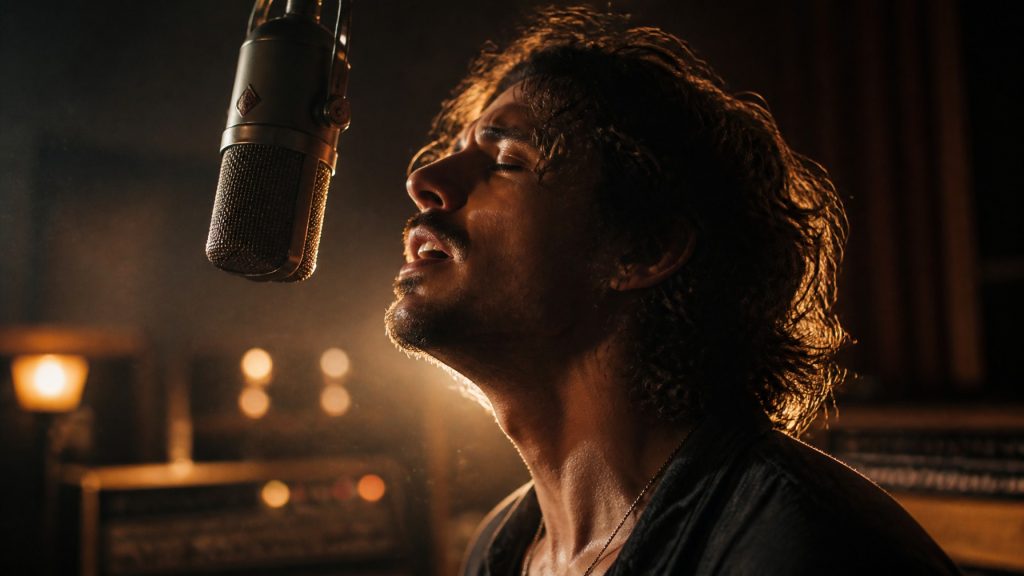
Some people sing well without training because singing accuracy is partly inherited and partly shaped by childhood music exposure. A twin study found that genes explained about 41 percent of the differences in singing ability, and shared family environment explained a similar amount. A natural singer usually has both a helpful genetic starting point and a musical home.
What Makes Someone a Natural Singer?
Good singing is a surprisingly complex skill. You have to hear a pitch, hold it in your mind, and then coordinate your breath, vocal cords, and muscles to reproduce it. Researchers usually measure singing ability by how accurately people match pitches and the distances between notes, known as intervals.
Natural singers tend to do this smoothly, without conscious effort. Their ears and voices seem to talk to each other without much help.
What Do Twin Studies Say About Singing?
In 2022, researchers tested 1,189 Australian twins on three everyday singing tasks using an online tool. They found that singing ability was moderately heritable, at about 40.7 percent, with a similar contribution of 37.1 percent from shared environmental factors. In other words, genes and the environment you grew up in mattered about equally.
The authors also noted that the existence of untrained people with excellent pitch accuracy supports the idea of an innate predisposition. That matches what many of us see at karaoke nights, where one friend effortlessly nails a tricky tune.
Does Your Childhood Matter as Much as Your DNA?
It seems to. In the same study, childhood singing in the family home and being surrounded by music early in life both predicted better singing ability. Shared environment includes things all siblings in a household experience, such as parents who sing, music playing in the car, or regular family singalongs.
That helps explain why singing talent often runs in families, even though not every sibling turns out equally gifted. It may be both nature and nurture working together.

Is It Really “Without Training”?
Usually “untrained” means no formal lessons, not no experience. Many natural singers spent years singing along to the radio, humming in the shower, or joining in at church, school, or family gatherings. That informal practice counts as exposure, and it likely sharpens the connection between ear and voice.
There is also a twist from research on musical ability more broadly. A large Swedish twin study reported that music practice itself is substantially heritable, and the connection between practice and ability was largely genetic. That suggests some people are born with both a stronger musical ear and a stronger urge to sing, which then feed each other. The finding is debated, but it fits the picture of a trait shaped by many influences.
Which Genes Are Involved?
No one has found a single “singing gene.” Like most complex skills, singing likely depends on many small genetic differences that affect hearing, auditory memory, motor control, and how the brain links sounds to movement. The twin study estimates how much genes matter overall, but it does not tell us which specific genes are responsible.
Perfect pitch, an unusual and separate ability, has its own genetic story, and we cover it in a separate post. Most good singers do not have perfect pitch. They simply have a reliable sense of relative pitch and a voice that obeys it.
Can You Improve Your Singing?
Almost certainly. Because genes explain roughly 41 percent of the differences in singing accuracy, a large share comes from other factors, including environment and experience. Record yourself singing along to a favorite song, listen back, and notice where you drift. Try humming a note, then matching it with a piano app or tuner. Sing often, in short sessions, and warm up gently.
If your voice often feels hoarse or sore, it is worth checking in with a doctor. Singing should feel comfortable, not strained.
Curious About Your Own Wiring?
A DNA report cannot tell you whether you can carry a tune, but it can help you explore how your genes relate to broader traits, such as stress response and sleep. SelfDecode turns your DNA data into personalized health recommendations, a handy starting point if you are curious. You might also enjoy our posts on the genetic basis of perfect pitch and why some people get goosebumps from music.