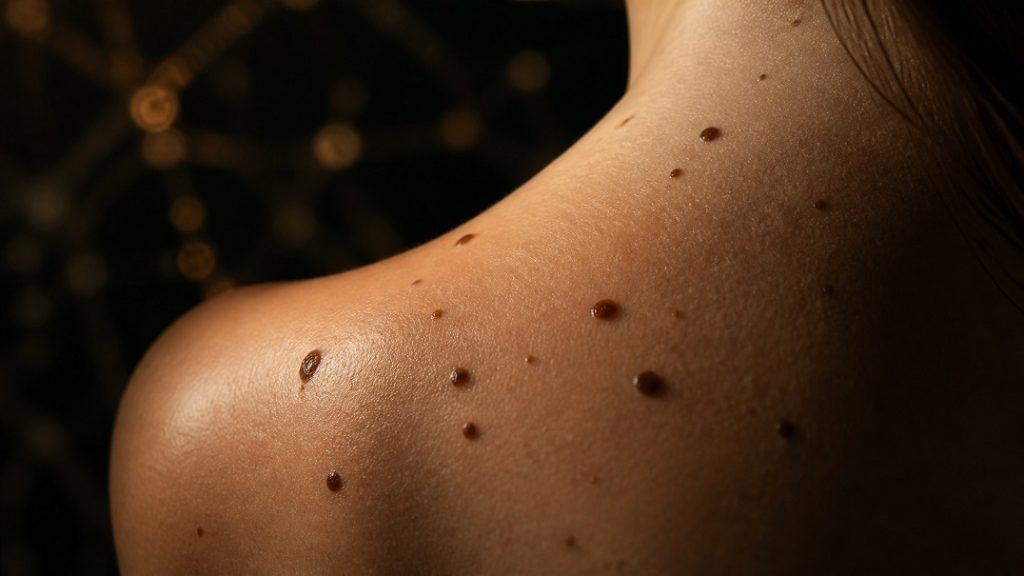
Some people have lots of moles because the number of moles you develop is strongly inherited, with sun exposure in childhood adding to the total. Twin studies show that genes explain a large share of mole count, and researchers have linked specific genes, including MTAP and CDKN2A, to it. A high mole count is usually harmless, but it does raise the importance of regular skin checks.
What Is a Mole?
A mole, or nevus, is a cluster of pigment cells. Moles develop when melanocytes grow in groups rather than spreading out evenly across the skin. They first appear in childhood and, according to twin researchers, increase in number rapidly in adolescence.
How Much of Mole Count Is Genetic?
A great deal. In an Australian twin study, researchers found that total nevus counts correlated at 0.94 in identical twin pairs and 0.60 in fraternal pairs, compatible with a very high degree of genetic determination. The same study estimated heritability at 0.69 for raised moles and 0.42 for flat moles, which suggests the two types have different causes.
In plain terms, identical twins tend to have nearly the same number of moles, even when they live different lives. If your parents or siblings are covered in moles, yours will probably follow suit.
Which Genes Are Involved?
Several have been found, and many sit near genes linked to melanoma. A genome-wide study of 1,524 adult female twins reported that SNPs in two genes, MTAP on chromosome 9 and PLA2G6 on chromosome 22, were significantly associated with higher mole counts. The same variants predicted melanoma risk in thousands of cases worldwide, and the effect appears to be mediated by the increased number of moles.
Other work has linked nevus count to IRF4 and to the CDKN2A region on chromosome 9. A 2024 conference abstract describing a meta-analysis of more than 85,000 people reported 28 mole-count loci, a sign of just how polygenic the trait is. No single gene decides how many moles you will have.
How Does the Sun Fit In?
Sun exposure turns up the dial. A British Journal of Cancer study comparing twins in the United Kingdom and Australia found that Australian children had approximately 40 percent more moles than UK children, presumably reflecting greater exposure to the sun. The two groups had similar ancestry but very different UV exposure, which makes the comparison a useful natural experiment.
The lesson is that genes load the gun and the sun helps pull the trigger. You cannot change your genes, but sun protection in childhood and beyond is within reach.
Does Having Many Moles Raise Melanoma Risk?
Somewhat. Mayo Clinic notes that having more than 50 ordinary moles indicates an increased risk of melanoma. The Merck Manual describes the increase as somewhat higher and adds that atypical moles raise risk as well.
It helps to keep this in perspective. Most moles never become cancerous, and having many moles is not a diagnosis. It is a reason to be watchful.
What Should You Do If You Have Many Moles?
Know your skin and see a dermatologist about a routine exam schedule. Use the ABCDE guide to spot warning signs: Asymmetry, irregular Borders, multiple Colors, a Diameter larger than about a quarter inch, and any Evolving change in size, shape, or color. Take photos so you can compare over time, and book a visit promptly if a mole changes, itches, bleeds, or looks different from the rest.
Prevention matters just as much. Mayo Clinic notes that the American Academy of Dermatology recommends a broad-spectrum, water-resistant sunscreen with an SPF of at least 30, and that tanning beds can increase skin cancer risk. The Merck Manual also points out that removing all atypical moles does not prevent melanoma, so regular screening matters.
Curious About Your Own Wiring?
A DNA report cannot count your moles or diagnose skin cancer, but it can help you explore how your genes relate to broader traits, such as skin pigmentation and sun sensitivity. SelfDecode turns your DNA data into personalized health recommendations, a handy starting point if you are curious. You might also enjoy our post on the genetics of freckles.