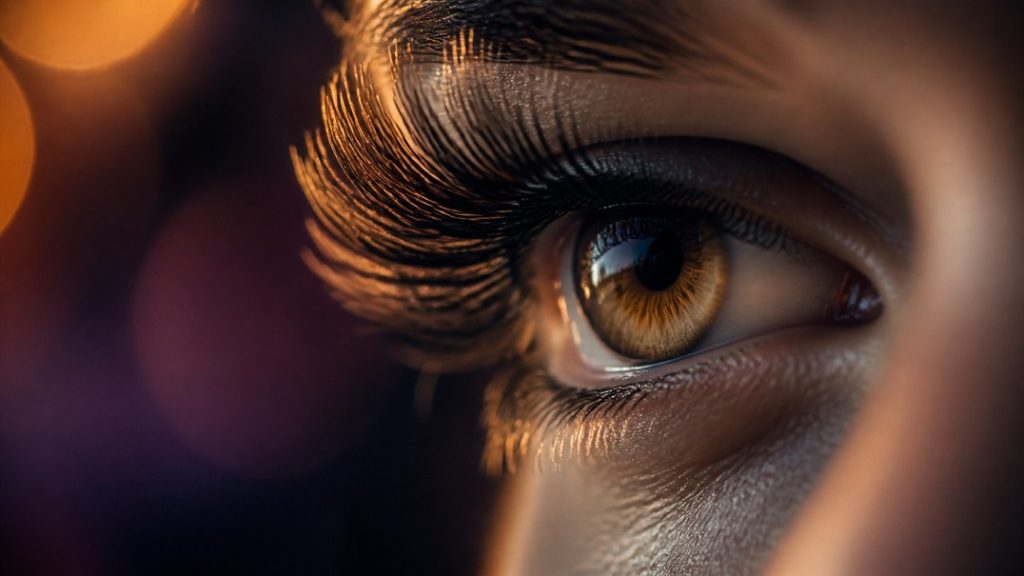
Some people have long, thick eyelashes because their lash follicles stay in the growth phase longer and produce more or sturdier hairs, and those traits are largely inherited. Hundreds of DNA markers appear to be involved, including the FGF5 gene, which helps tell hairs when to stop growing. Genetics explains a meaningful share of the difference, while hormones, medications, and lifestyle account for the rest.
How Do Eyelashes Grow?
Eyelashes follow the same cycle as other hair: a growth phase, a short transition phase, and a rest phase before the lash falls out and a new one starts. The growth phase is called anagen, and its length is the main reason lashes differ. A follicle with a longer growth phase has more time to build a longer lash, while a shorter growth phase caps length early.
Thickness is a bit different. It likely depends on the diameter of each hair and on how many lash follicles are active at once, which together create that full, dense look.
What Does the FGF5 Gene Do?
FGF5 is the best-known lash length gene. Researchers studied families in Pakistan with familial trichomegaly, a condition of extremely long eyelashes, and identified distinct mutations in FGF5 that underlie the disorder. Hairs from the affected patients were significantly longer than hairs from control individuals, with a larger share in the growth phase. The team also showed that FGF5 pushes human hair follicles toward regression, meaning it acts like a brake on the growth phase.
When FGF5 works normally, it signals the follicle to stop growing. When it is disrupted, the brake is weaker and lashes keep growing longer. Trichomegaly is rare, though, and it shows an extreme version of a spectrum that most of us sit somewhere on.
How Much of Lash Length Is Genetic?
Quite a lot. The AncestryDNA research team asked over 750,000 people to describe the natural length of their eyelashes and compared answers with their DNA. They found over 820 DNA markers related to eyelash length and concluded that at least 25 percent of the variation is due to genetics. The number of markers shows that lash length is polygenic, meaning it reflects many small genetic nudges.
The study relied on self-reported descriptions, so the percentage is a rough guide. The big picture is clear, though: if your parents have long lashes, yours may be too.
What Else Affects Lash Length and Fullness?
Genes are not the whole story. Hormones influence hair growth throughout the body, and unbalanced hormones can affect your eyelashes. Eye rubbing, harsh makeup removal, and extensions can also pull lashes out early.
Medications can have a striking effect. Bimatoprost, a glaucoma drug, was found to lengthen and darken lashes as a side effect, which led to its approval as a lash treatment. The FDA-approved labeling says that upon discontinuation of treatment, eyelash growth is expected to return to its pre-treatment level. The same label notes that increased iris pigmentation has occurred, which is one reason to see an eye doctor before using any such product.
How Do Lash Treatments Fit the Growth Phase Story?
That bimatoprost story reinforces the genetics. Trade reporting on its approval explained that growth is believed to occur by increasing the percentage of hairs in, and the duration of, the anagen or growth phase. In other words, the drug works on the same lever that FGF5 and your inherited growth cycle control.
Are Long Lashes Just Cosmetic?
Mostly, yes, though lashes do protect the eye by catching dust and debris. If your lashes suddenly thin out, fall out in patches, or grow in different directions, mention it to an eye doctor or dermatologist, since changes can sometimes point to a skin, hormone, or inflammation issue. Otherwise, treat your lashes gently. Remove eye makeup with a soft touch, avoid pulling at lashes, and replace old mascara to reduce irritation.
Curious About Your Own Wiring?
A DNA report cannot measure your lashes, but it can help you explore how your genes relate to broader traits, such as hair growth and hormone response. SelfDecode turns your DNA data into personalized health recommendations, a handy starting point if you are curious. You might also enjoy our post on the genetics of straight versus curly eyelashes.