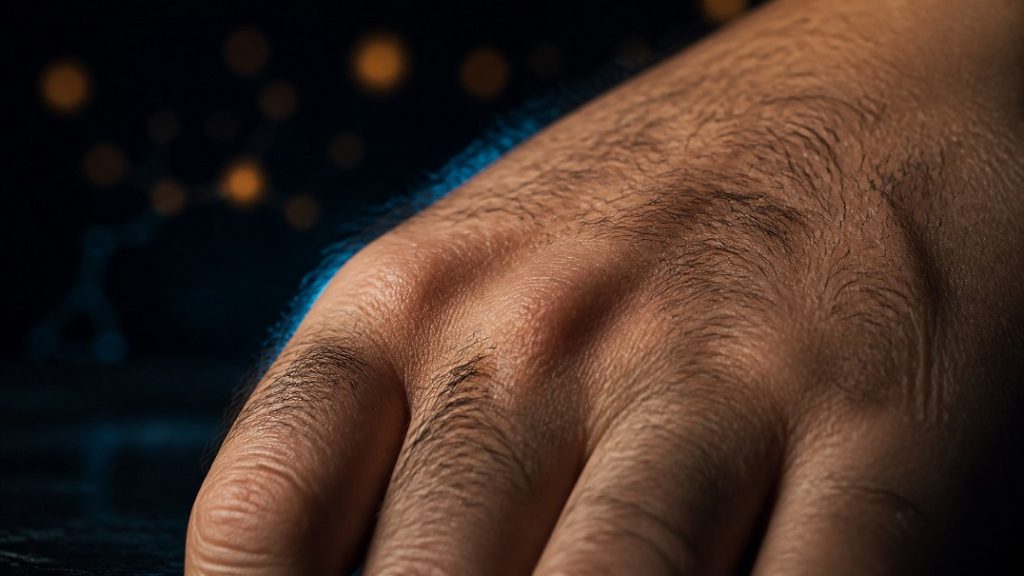
Some people have hairy backs, toes, or knuckles because their hair follicles in those spots grow thick, dark terminal hair instead of the fine, nearly invisible kind. Hormones called androgens drive that switch, and how strongly each follicle responds is largely inherited. Family background and ancestry shape the pattern, which is why extra hair in these places is usually just a family trait.
Why Does Some Hair Look Coarse and Other Hair Barely Show?
Almost every part of your skin has hair follicles. What differs is the type of hair. The American Society for Reproductive Medicine explains that vellus hair is soft, fine, and generally colorless, while terminal hair is long, coarse, and dark. Where your follicles make terminal hair, you notice hair. Where they make vellus hair, you do not.
What Role Do Androgens Play?
Androgens, the hormones that include testosterone, decide a lot of it. The ASRM notes that if hair follicles are hormone-sensitive, androgens may cause some vellus hairs to change to terminal hairs, and once a hair has changed, it usually does not change back. A medical textbook chapter calls androgens the most important determinant of the type and distribution of hairs throughout the body.
Follicles vary in how sensitive they are, and that sensitivity is inherited, so two brothers can end up with very different amounts of back hair.
Why Do Some People Get Hairy Backs?
The upper back, shoulders, and chest are among the sites where follicles respond to androgens. According to the ASRM, terminal hair covers the face and body in most men, so back hair is within the normal range for men. The amount depends on family patterns and ancestry, since hair density varies by ethnic origin.

What About Hair on Knuckles and Toes?
This is a classic trait called mid-phalangeal hair, meaning hair on the middle segment of the fingers or toes. A genetic database entry summarizing the older research explains that hair is present on the middle segment of the fingers more frequently than on the toes, is most often found on the fourth finger, and shows wide fluctuation with apparent familial and racial tendencies. The same entry reports it more often in men than in women.
Healthline describes knuckle hair as a genetic trait with no medical reason to remove it.
Is It Really a Single Dominant Gene?
You may have learned in biology class that hair on the knuckles is a simple dominant trait. That turns out to be an oversimplification. A genetics educator who reviewed the research argues that family studies show mid-digital hair is not a simple genetic trait, and notes that the trait is hard to score because the hairs can be thick or very fine, and can appear on one finger or on several.
When Is Extra Hair Worth Mentioning to a Doctor?
For most people, a hairy back or knuckles is simply normal. The situation is different for women who develop coarse hair in male-pattern areas. The ASRM defines that as hirsutism, noting that excess facial and body hair is usually the result of excess androgens in the body, and it can reflect polycystic ovary syndrome or other conditions. A doctor can tell whether the cause is hormonal or simply inherited, because a family or ethnic predisposition is also common.
Women who notice coarse hair appearing suddenly or increasing quickly, especially with irregular periods, acne, or a deepening voice, should seek advice.
Can You Remove Unwanted Hair Safely?
You can, and there is no medical need to do so. Healthline lists shaving, depilatory creams, waxing, electrolysis, and laser hair removal, and notes that electrolysis and laser hair removal damage the hair follicle so hairs do not grow back as frequently. Laser works best when hair is dark and skin is lighter. A dermatologist or licensed professional can help you choose a method that fits your skin and hair.
Curious About Your Own Wiring?
A DNA report cannot predict where your body hair will grow, but it can help you explore how your genes relate to broader traits, such as hormone response and hair growth. SelfDecode turns your DNA data into personalized health recommendations, a handy starting point if you are curious. You might also enjoy our post on the genetics of curly hair.