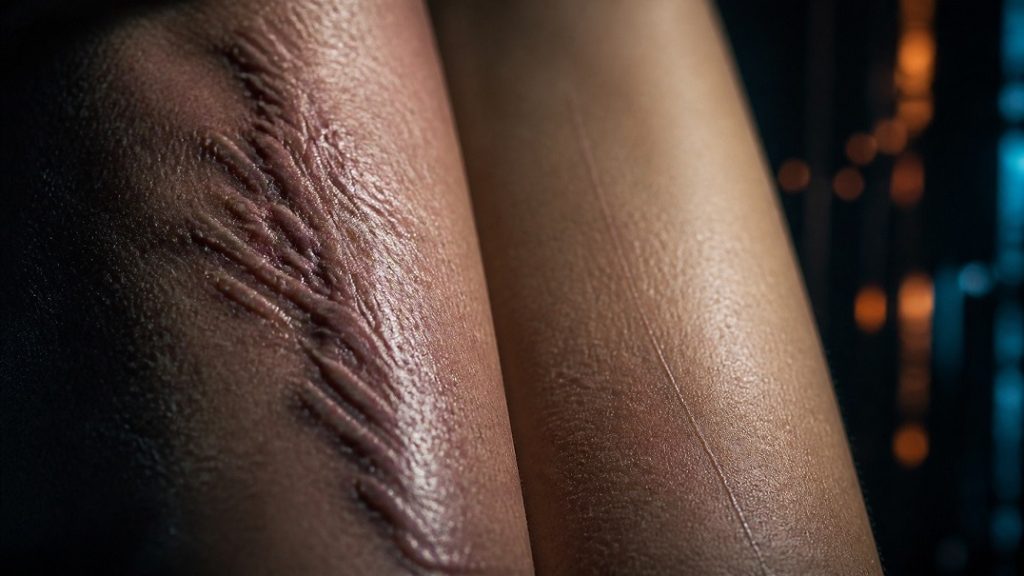
Some people scar badly because their bodies make extra collagen when healing, and that tendency is partly inherited. Genes, skin tone, age, and the depth and location of a wound all shape the result. Some people, especially those prone to keloids, can form large raised scars from small injuries, while others heal almost cleanly from the same cut.
How Does a Scar Form?
A scar is the body’s repair job. Cleveland Clinic explains that when skin is injured, the body creates new tissue made of collagen to help reseal itself. Collagen fibers repair damaged skin and close open areas, and the new tissue protects you from infection.
Scar tissue is not identical to the skin it replaces, which is why scars can look and feel different from the surrounding skin.
What Decides How Bad a Scar Looks?
Many factors work together. According to Cleveland Clinic, a scar’s appearance depends on the size, severity, and location of the wound, as well as your age, genes, ethnicity, and overall health. A deep cut will usually leave a more visible mark than a scrape, and wounds over joints or the chest tend to heal with thicker scars than wounds on calmer patches of skin.
Two cuts that look alike can differ in depth, infection, and how much the skin was pulled during healing, and those details can quietly change the outcome.
What Are Keloids and Hypertrophic Scars?
These are the two raised scar types that people usually mean by “scarring badly.” Hypertrophic scars are thick and raised but stay within the boundaries of the original wound. Keloids grow beyond the edges of the original injury and can keep expanding.
A review in the journal Scars, Burns & Healing notes that the formation and growth of keloids and hypertrophic scars associate clearly with genetic, epigenetic, systemic, and local risk factors, particularly skin tension around scars. In other words, your genes and the physical forces on your skin work together.

How Much Do Genes Matter?
A fair amount, particularly for keloids. The same review states that keloid patients often have a family history of these scars, and that genome-wide research has found that four SNP loci in three chromosomal regions associate significantly with keloids. Researchers also point out that keloid and hypertrophic scar formation is complex and poorly understood, so no single gene explains who gets them.
If a parent or sibling developed a keloid after a piercing, surgery, or minor injury, you may have a higher chance of forming one too. Mention that history to your doctor before an elective procedure.
Does Skin Tone Play a Role?
Yes. Cleveland Clinic says that people with dark skin, especially those with African, Asian, or Hispanic heritage, as well as red-haired individuals, are more likely to develop keloid scars. In people with dark skin, scars also often appear as dark spots.
These are tendencies, not guarantees. Many people with darker skin never develop a keloid, and keloids can occur in anyone.
Why Do Some Body Areas Scar Worse?
Skin tension is a big reason. The review above highlights that mechanical forces on healing skin, which is skin tension, may influence the degree of scarring and the growth of keloids. Areas that stretch and move a lot, such as shoulders, chest, and joints, are under more tension than areas like the forearm.
What Can You Do to Scar Less?
Start with good wound care. Keep wounds clean, protected from infection, and out of the sun. Infection can add inflammation and make scarring worse, so clean, covered wounds generally heal better. Do not pick at scabs, which can break the new collagen and let germs in.
If you know you scar badly, tell your doctor or surgeon before any procedure so they can plan accordingly. Cleveland Clinic notes that some treatments are used to prevent a scar from forming as a wound heals, and that others treat existing scars. See a dermatologist if a scar becomes raised, itchy, painful, or keeps growing, since options such as injections, silicone products, and laser treatments exist. People with dark skin should ask about the risks of lasers, which can lighten or darken skin.
Curious About Your Own Wiring?
A DNA report cannot tell you how a particular cut will heal, but it can help you explore how your genes relate to broader traits, such as collagen and skin health. SelfDecode turns your DNA data into personalized health recommendations, a handy starting point if you are curious. You might also enjoy our post on why some people bruise at the slightest bump.