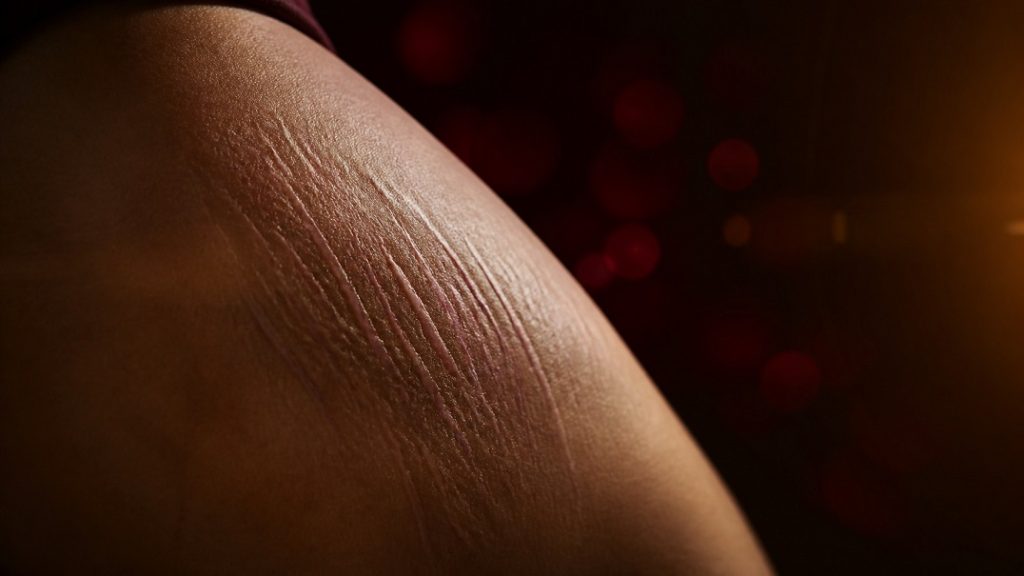
Some people get stretch marks easily because their skin’s elastic support, made of proteins like elastin and collagen, is more prone to tearing when the body grows or changes quickly. Genes play a real part. A large genetic study found variants near genes such as ELN, which makes elastin, linked to stretch marks. Pregnancy, growth spurts, weight changes, and some medications then trigger them.
What Is a Stretch Mark?
A stretch mark is a type of scar. Medical News Today explains that stretch marks form in the dermis, the middle layer of skin, when connective tissue is stretched beyond the limits of its elasticity. As the body grows, the fibers in the dermis normally stretch slowly to keep up. When growth is too fast, the dermis tears, allowing deeper layers to show through.
New stretch marks often look red, pink, or purple, and they usually fade to a lighter, silvery color over time.
What Triggers Stretch Marks?
Anything that stretches the skin quickly can do it. The common triggers are pregnancy, puberty, and rapid weight gain or loss, and the same source notes that over 50 percent of women experience stretch marks during pregnancy.
Medications and medical conditions matter too. Mayo Clinic lists a personal or family history of stretch marks, rapid weight changes, corticosteroid use, and genetic disorders such as Cushing syndrome or Marfan syndrome among the risk factors.
Why Do Some People Get Them and Others Do Not?
Two people can gain the same weight or go through the same pregnancy, and only one ends up with marks. The difference lies partly in the skin’s structural proteins. Collagen and elastin keep skin firm and stretchy, and researchers note that the expression of collagens, elastin, and fibronectin is decreased in stretch marks, which may be linked to the loss of elastic fibers in affected skin.
Skin with more resilient elastic fibers, or skin that stretches more gradually, is likely less prone to tearing, and that resilience is probably partly inherited.
What Did the Genetic Study Find?
The first large genetic study of stretch marks came from 23andMe and analyzed DNA from 33,930 unrelated people of European descent. According to a summary of the work, four genetic regions were significantly associated with stretch marks. The strongest signal sat near the ELN gene, which encodes elastin, and was also seen in women who had stretch marks during pregnancy. Another was a variant in the SRPX gene, and a third was in HMCN1.
The researchers said it is unclear how some of these regions affect stretch mark risk, and that more work is needed. Still, the elastin connection is a satisfying clue. It fits what doctors see: a family history of stretch marks raises your odds.
Is It Your Fault If You Get Them?
Not at all. Stretch marks are common, with prevalence estimates ranging from 50 to 80 percent, and they are harmless. Genes, hormones, and the speed of body changes are mostly out of your control. Creams and oils are sold in huge numbers, but Mayo Clinic says that it is unlikely such products will completely erase the appearance of stretch marks. If you hear a promise that a cream will prevent them, be skeptical.
What Helps?
Prevention is limited, but small steps can help. Medical News Today suggests maintaining a healthy weight and aiming for slow, gradual weight gain during pregnancy. If you take a corticosteroid cream or tablet for a long time, ask your doctor whether it could be contributing.
For existing marks, time is the best treatment. They usually fade on their own, and Mayo Clinic says they do not require treatment, although treatment may make them fade and they may never completely disappear. Options a dermatologist might suggest include prescription tretinoin, which when it works helps rebuild collagen, and light or laser therapy. Results vary, so ask about realistic expectations.
When Should You See a Doctor?
Stretch marks are usually harmless, but see a doctor if they appear widely and quickly without a clear cause such as pregnancy, puberty, or weight change. Conditions such as Cushing syndrome and Marfan syndrome are associated with stretch marks and deserve evaluation.
Curious About Your Own Wiring?
A DNA report cannot predict your stretch marks, but it can help you explore how your genes relate to broader traits, such as skin elasticity and collagen. SelfDecode turns your DNA data into personalized health recommendations, a handy starting point if you are curious. You might also enjoy our post on why some people bruise at the slightest bump.