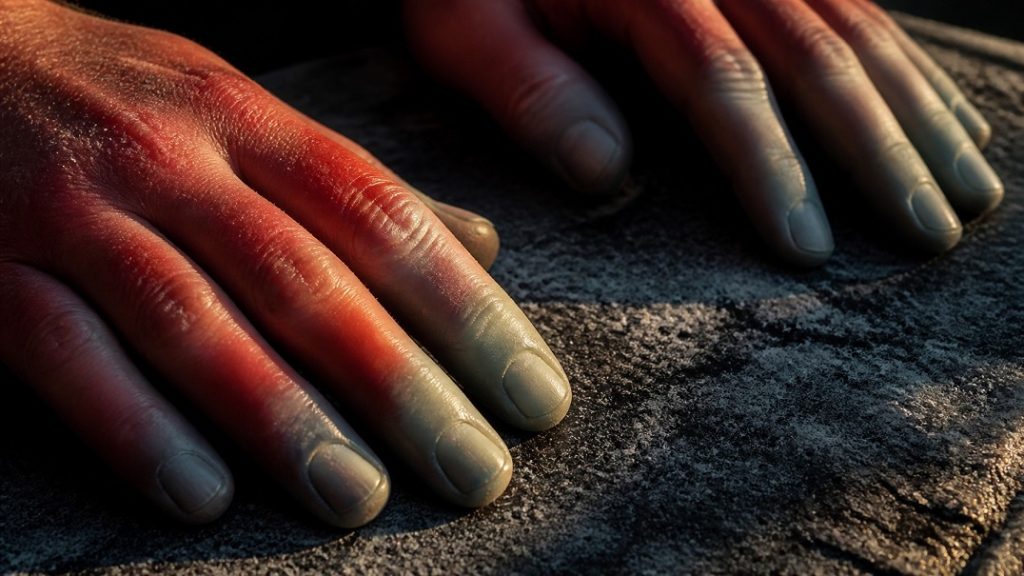
Some people get painfully cold hands and feet because of Raynaud’s phenomenon, a condition in which small blood vessels in the fingers and toes overreact to cold or stress. The vessels clamp down, blood flow drops, and the skin turns white or blue. The most common form runs in families, and researchers have now linked it to specific gene variants.
What Is Raynaud’s Phenomenon?
Raynaud’s is more than ordinary chilly fingers. According to the National Institute of Arthritis and Musculoskeletal and Skin Diseases, attacks affect certain parts of the body, especially the fingers and toes, causing them to become cold, numb, and change colors. The NIAMS explains that attacks come from an intensification of the body’s natural response to cold. Stress can trigger them too.
During an attack, a fingertip may turn white, then blue, then red as blood flow returns. That color shift is a helpful clue that you are dealing with something beyond everyday cold hands.
What Is the Difference Between Primary and Secondary Raynaud’s?
There are two forms. Primary Raynaud’s has no known cause, while secondary Raynaud’s is associated with another problem, such as a rheumatic disease like lupus or scleroderma. Primary Raynaud’s is by far the more common type and is usually diagnosed in teenage girls and women in their 20s.
Secondary Raynaud’s tends to begin later in life, typically after age 35 to 40, and it can cause more serious problems, such as sores on the fingertips. Doctors can usually tell the two apart with a history, a physical exam, and a few tests.
How Common Is Raynaud’s?
It is fairly common. News coverage of a major genetic study reported that it affects about 2 to 5 percent of the population, more often women. The NIAMS notes that more women than men have the primary form, which suggests that estrogen may play a role.
Does Raynaud’s Run in Families?
Yes, strongly. The NIAMS says that people with a family member who has Raynaud’s have a higher risk of getting it themselves, suggesting a genetic link. One rheumatology expert told reporters that about half of the people with primary Raynaud’s have a first-degree relative who also has it.
If your mother, sister, or father has fingers that turn white in the cold, your own cold hands may not be a coincidence.
Which Genes Are Involved?
In 2023, researchers published the largest genetic study of Raynaud’s to date in Nature Communications. It used data from more than 440,000 people in the UK Biobank, including more than 5,000 people with Raynaud’s. They identified two genes whose variants were linked only to primary Raynaud’s. People with one of the variants had higher numbers of a receptor that responds to hormones released during stress or cold.
That finding makes biological sense, because Raynaud’s attacks are triggered by cold and stress. It also raises hope for treatment, since an existing medication acts on that receptor and might be repurposed, although that still needs testing. No single gene decides who gets Raynaud’s, and the condition likely reflects several genetic influences plus environment.
When Should You See a Doctor?
See a doctor if you have attacks, particularly if they start after age 35 to 40, or if you develop sores, ulcers, or skin changes on your fingers or toes. Secondary Raynaud’s can signal an underlying condition, and finding it early matters. Mention any joint pain, rashes, or tight skin, since these can point toward a connective tissue disease.
How Can You Manage Cold Hands and Feet?
For primary Raynaud’s, lifestyle changes often work well. Experts say that symptoms of primary Raynaud’s are often manageable with measures such as avoiding cold and limiting stress. Wear gloves, warm socks, and layers, and warm up your hands before heading out. Keep your whole body warm, since a cold core can trigger an attack in the extremities. Do not smoke, since nicotine narrows blood vessels.
If lifestyle steps are not enough, medications exist, so ask your doctor about options rather than putting up with painful attacks.
Curious About Your Own Wiring?
A DNA report cannot diagnose Raynaud’s, but it can help you explore how your genes relate to broader traits, such as circulation and stress response. SelfDecode turns your DNA data into personalized health recommendations, a handy starting point if you are curious. If your family has a pattern of cold, color-changing fingers, share that history with your doctor, because it is useful information.